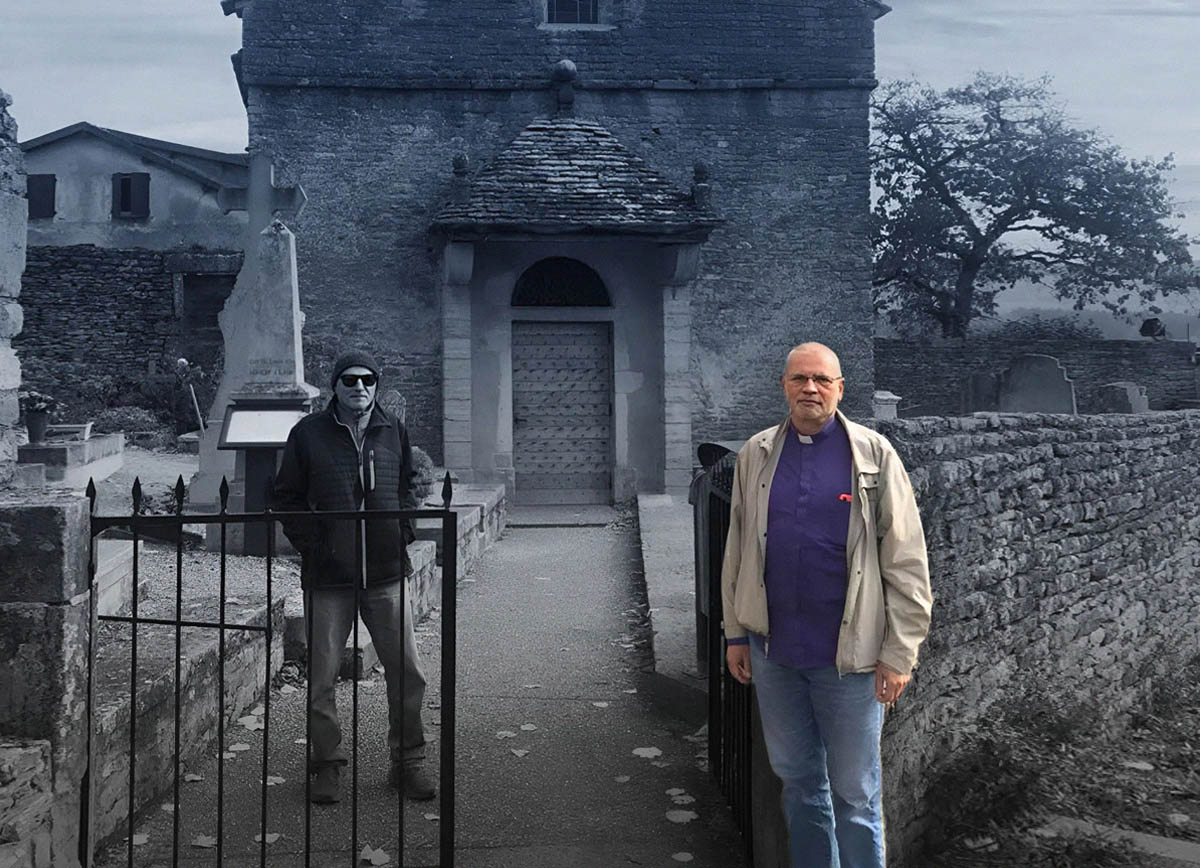
Alexander Shvedov (right)
Alexander Shvedov calls himself a physicist, a Catholic, a deacon, and a political emigrant.
He graduated from the Faculty of Aeromechanics and Flight Engineering of the Moscow Institute of Physics and Technology (FALT MIPT), then worked at TsAGI, developing aviation science. In the early 90s, Shvedov became the chairman of the City Property Committee in Zhukovsky, Moscow region, and one of the young reformers who thought outside the box and offered creative solutions. At the dawn of perestroika, there was a pedestal for a Lenin monument in the city, the monument itself was ready but not installed. The communists, despite everything, insisted on its installation. Shvedov suggested they create a society for the protection of the leader of the world proletariat, buy the monument, and take it out of the city to someone's dacha to worship there.
In 2005, the former physicist and reformer converted to Catholicism, a few years later graduated from the Ukrainian Catholic University in Lviv, and after the annexation of Crimea, in 2017, was ordained a deacon of the Ukrainian Greek Catholic Church and began serving in Crimea.
«There was a publication about me in one of the z-channels, and at the end, a call: here is a form for a statement to Bastrykin, send it and report back in the comments. And already 40 people wrote that they sent it. Then I realized that this would not end just like that»
This was a special project of the Metropolitan of Odessa and Crimea, which was planned to be implemented in Crimea already under Moscow's control: five small communities. And although Ukrainians were leaving (there were 300 people before, only 30 remained), it was planned that Russian-speaking parishioners would come.
«...The community's rector was taken to the basement in 2014 because of a photo of Stepan Bandera on the wall, he left immediately after that, I lived right in his house, it wasn't even a church, but an adapted room...»
Six months later, it became clear that the project needed to be closed, Shvedov's pass to Crimea expired because he deliberately entered from the Ukrainian side. By this time, it had simply become unsafe to be there: a private house, once bought to make a church there, was sold by the new authorities with fake documents to some private individual.
«...I got a call from the neighboring house and was told that construction had started in our church, I ran over, and there were already "real estate company representatives" standing there. I informed them that this was our house, after which he grabbed me by the chest shouting "Police!" And we rolled on the ground. I realized that I couldn't handle them, packed up that evening, and left...»
After that, the deacon served in Moscow on Malaya Gruzinskaya for Ukrainian Catholics in the Ukrainian language, and at the same time wrote on Facebook* and spoke on YouTube about what he thought of Russia's criminal war against Ukraine. Ultimately, in the summer of 2023, z-bloggers raised the issue sharply, demanding at most physical violence and at least criminal prosecution.
In addition, Shvedov became one of the "heroes" of the denunciation collection by Orthodox activist Alexander Voznesensky (it was his denunciation that initiated the church process against Andrey Kuraev in 2020). «As for the Nazi and Russophobe Shvedov, it's simply outrageous that he is still free», — lamented Voznesensky.
«...At some point, acquaintances called me: do you know what's being written about you on the internet? And I didn't know because I live my life. I opened it and started reading.
In one of the z-channels, there was a publication about me, and at the end, a call: here is a form for a statement to Bastrykin, send it and report back in the comments. And already 40 people wrote that they sent it. Then I realized that this would not end just like that...»
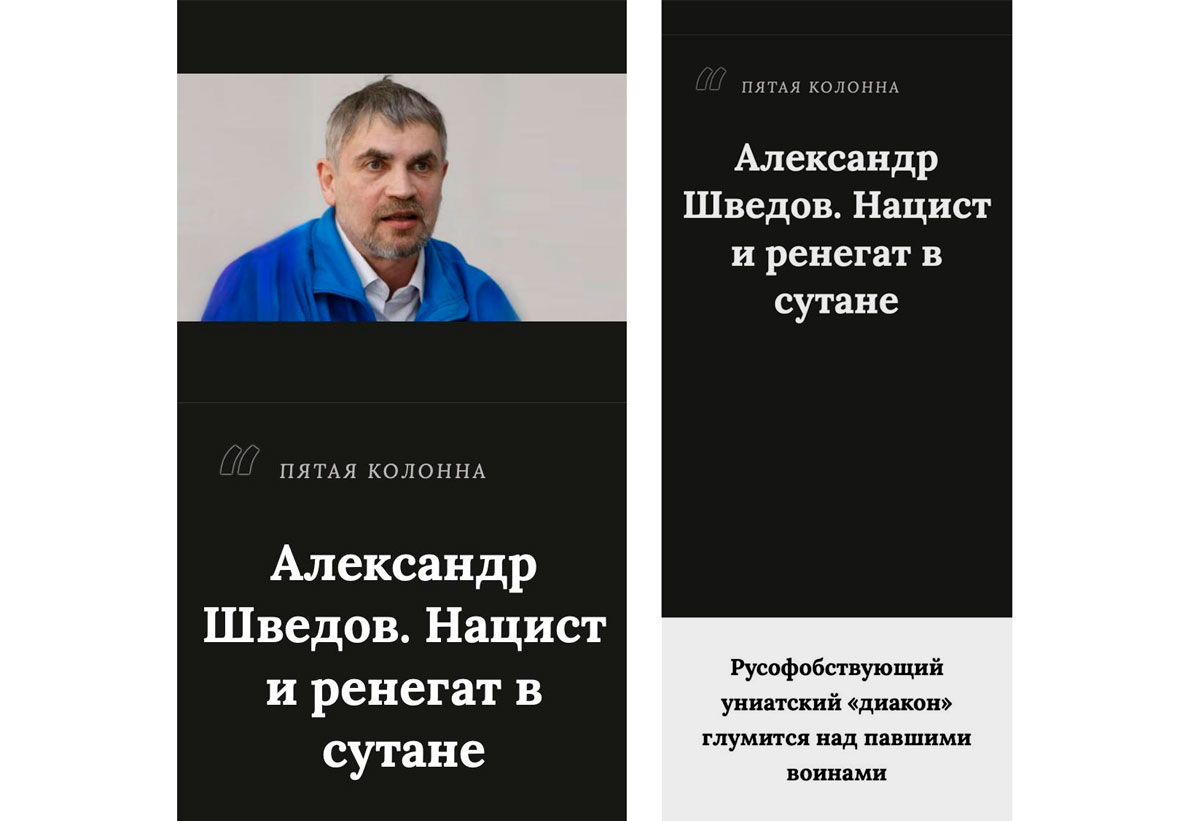
In August 2023, Shvedov left for Armenia. After leaving, the police came to his home and left a note in the door asking him to call the investigator. He called from Yerevan, but when asked about his whereabouts, he answered evasively: «In a conditionally friendly country». «Ukraine?» — the investigator tried to guess. Then he suggested returning and coming for a conversation. «When the wind changes, then I'll return», — Shvedov replied. The police were unable to open an administrative case on "discrediting" the Russian army, as they could not question the "discreditor" within the time limits set by law (an absentee decision is not made for administrative offenses).
Shvedov lived in Armenia for a year and a half, worked for half a year as a physics teacher in a Russian-speaking school, «the students loved me, and I loved them too». He rented a room; the owner's aunt, a Russian language and literature teacher, registered him at her place, which allowed him to legalize.
«...I planned to stay in Armenia for a long time and work as a teacher at school. I learned to read and write in Armenian, there were free courses from the state for those who really want to assimilate...»
There is no Byzantine community service in Armenia, there was only a Catholic priest, an Argentinean, who spoke Russian quite well. Sometimes services were held in Russian in the Latin rite, in which a deacon is not very necessary. And when there were large services in English, at the request of the priest, Shvedov read the Bible in English.
«Won the lottery»: refugee status in France
In the spring of 2024, a new roommate moved in, and the new companion asked why Alexander did not apply for asylum in Europe.
«...Honestly, I hadn't even thought about it. He gave me contacts at the Sakharov Institute in Paris, I described my situation, and six months later I was given a humanitarian visa to France...»
In February 2025, Shvedov flew to Paris, applied for asylum, and confirmed his documents a month and a half later. At the end of March, he was placed in a temporary shelter in Grenoble, and in May, he was moved to a permanent shelter in Valence.
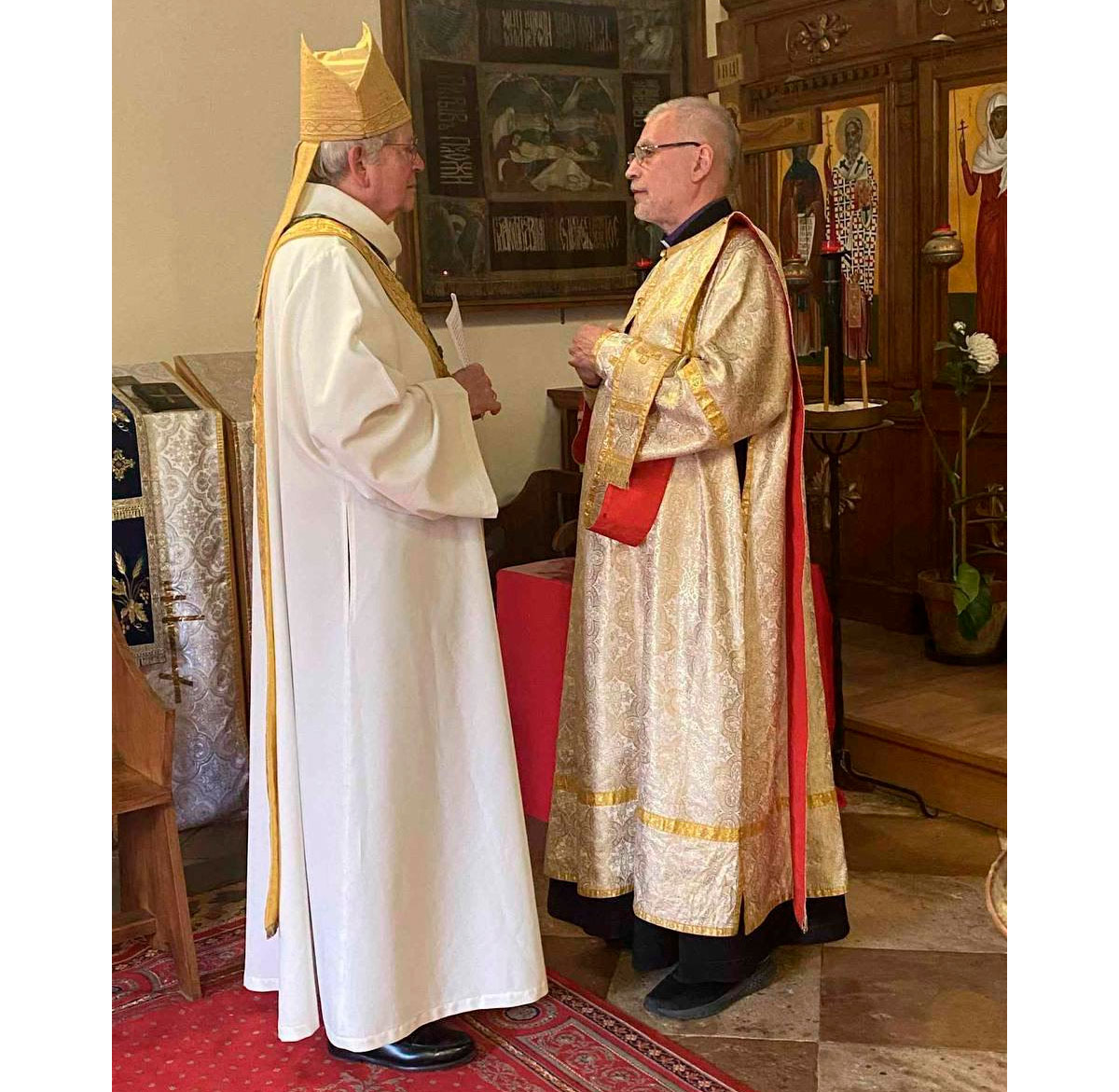
Alexander Shvedov with the Metropolitan of Paris
In Lyon, which is a 1 hour 10-minute train ride from Valence, there is a Byzantine rite parish of St. Irenaeus. Lyon priest Paul Couturier in the early 1930s encountered Russian emigrants of the first wave, who lost everything but piously kept their icons as a testament to the faith inherited from their ancestors. A small number of these refugees asked to be accepted into the Catholic Church. On December 18, 1932, a chapel for Russian Catholics was opened. In 1956, it became a parish. The White Guards themselves have long been gone, but two grandchildren come, who remember that their grandfather once taught them something Russian. There are Russian-speaking people in the parish — Russian and Ukrainian migrants.
«...I go there once a week, for the Saturday evening service and Sunday liturgy. There is a monastery where the rector kindly provides me with a bed and food...»
At the beginning of December, Shvedov was invited for an interview, and on December 24, a decision was made to grant refugee status and a residence permit with the right to work.
«I do not bow before AI, although some philosophers promote the idea that it is supposedly sinless, unlike humans. But it learns from texts created by sinful people. I wouldn't be surprised if it starts taking bribes in electronic money»
Shvedov himself believes that obtaining refugee status is a lottery:
«...Religious cases before me received positive decisions: Ioann Kurmoyarov, who served two years in a colony on charges of military "fakes", Chelyabinsk priest Nikolai Platonov. But you have to prove it seriously, building a clear argument. I had a large folder collected. For example, in Yekaterinburg, a person was imprisoned, and in the sentence, his communication with a Greek Catholic priest living in Rome was included as justification. And it is directly written there that the Greek Catholic Church is an enemy of Russia. And this priest from Rome is my close friend for 20 years, and naturally, I also correspond with him. Therefore, in Russia, by all parameters, I should have been imprisoned...»
The percentage of refusals from Russia is high also because positive decisions are more often made on LGBT cases, which many take advantage of:
«...As far as I know, natives of a small but proud southern republic are fleeing en masse and initially apply as LGBT, in most cases having no grounds for this. Just while the documents are being considered for six months, they can live in France. This greatly spoils the statistics...»
Wind turbine mechanic and deacon of the Catholic parish
With the receipt of documents, the emigrant from Russia began looking for a job, and he knows firmly what kind — a wind turbine mechanic.
«...I love heights, in my youth, I was engaged in industrial mountaineering, painting factory pipes from ropes, plus aerodynamics, which they taught me at FALT. I wrote a giant motivational letter with the help of AI and started moving towards this profession. I am used to working with inanimate objects, it is easier for me with them. I worked for twenty years in a pharmacy warehouse, as I call it, "twisting the tails of forklifts", I had two mechanics under my supervision. "Wind turbines" are also inanimate, I read a lot and watched videos about this work. A combination of knowledge in aerodynamics, technical maintenance skills, and experience working at heights is, in my opinion, the ideal combination for such work. So I will try, look for vacancies, I will need to undergo training, but I am ready for this, the road will be mastered by the walking...»
Within six months after acquiring refugee status, it is necessary to leave the shelter, Shvedov decided to move to social housing in Lyon to live near the parish:
«...I have mastered French enough to already be able to announce deacon's exclamations in church. In addition, I wrote a sermon: I uploaded my thoughts into AI, it shaped them into a sermon, and after my corrections, translated it into French, the audience liked it.
I do not bow before AI, although some philosophers promote the idea that it is supposedly sinless, unlike humans. But it learns from texts created by sinful people. I wouldn't be surprised if it starts taking bribes in electronic money.
It is a tool with which I organize my thoughts, for example, I write sermons, motivational letters when applying for a job, documents to government agencies. I even wrote a script for a film with the help of AI for "Kazakhfilm"...»
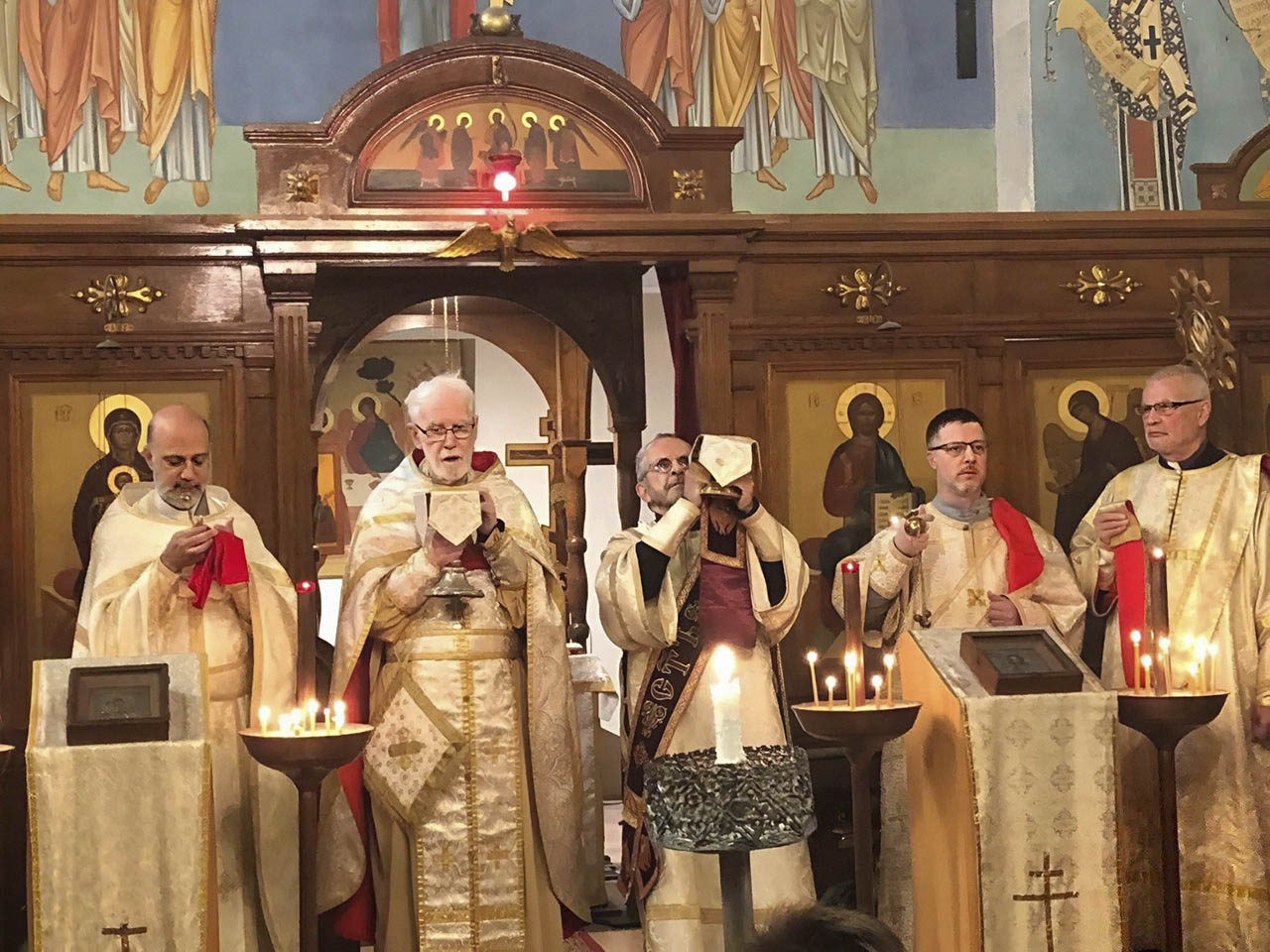
In the parish of St. Irenaeus in Lyon
With the help of AI, Shvedov is also learning French. He uses DeepSeek — a Chinese neural network, says he is satisfied with everything, but there is a nuance: it categorically refuses to talk about the atrocities of the "cultural revolution" in China, the Red Guards, and Chiang Kai-shek, who is called the "Chinese Bonaparte". But it gladly explains the structure of certain hieroglyphs.
«...I would like to obtain permanent status, take priesthood, and then — whatever is best for the church. I met the Archbishop of Paris: he came, and I told him my story. Besides, once I was in Paris at an event among parishioners, he served, walked by, and nodded to me. To be honest, I was pleased that the Metropolitan of Paris recognized me in the crowd. By the way, the Archbishop of Lyon rides a bicycle around the city — I met him several times on the streets.
And in the summer I passed through Marseille, approached the main church, and there the service had just ended, parishioners were talking in the yard with the Archbishop of Marseille, a Cardinal of the Catholic Church, who also knows me because he came to Armenia. We met there and talked...»
Now Alexander Shvedov is busy processing a large number of documents in connection with his new status and is pondering new opportunities.
«...I will look for a job, I will serve, continue to express my opinion on the internet. As Friedrich Nietzsche said: «That which does not kill us makes us stronger»...»
* Facebook — a product of the company Meta, which is recognized as an "extremist organization" in Russia.
Photo from the archive of Alexander Shvedov.